Osmotic therapy · Electrolyte
Hypertonic saline
Also called 3% saline, 23.4%
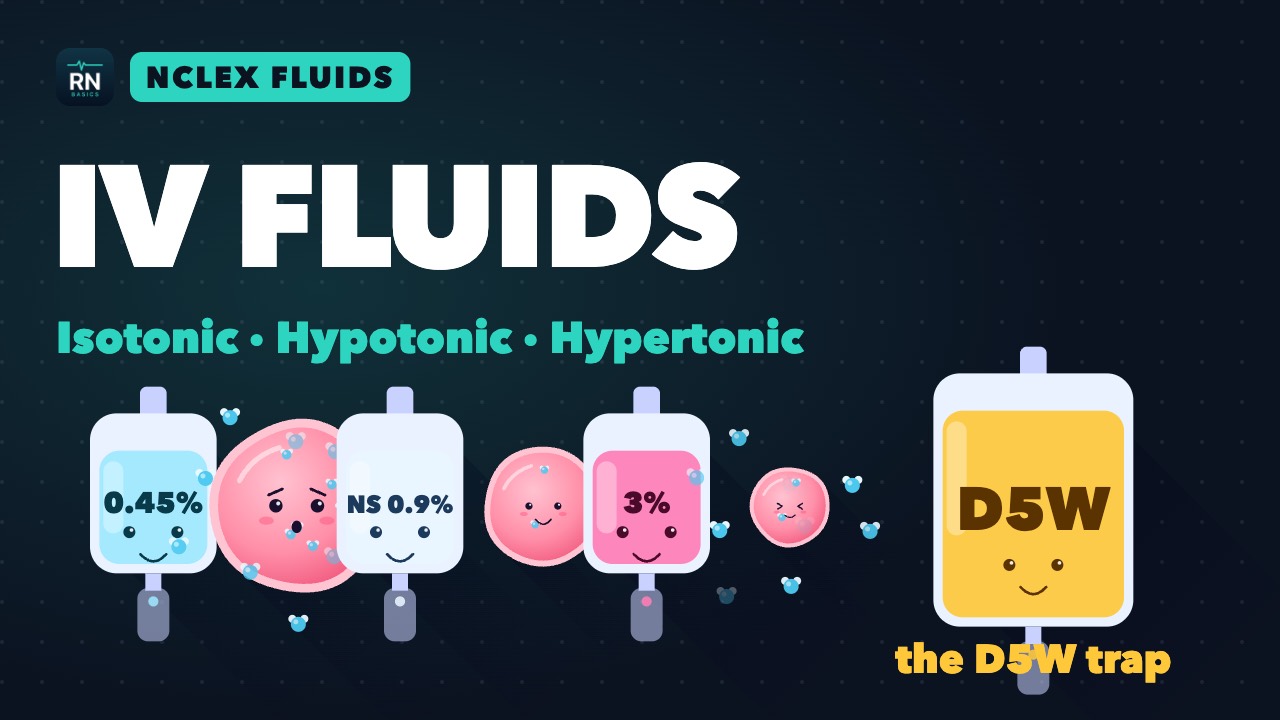
Watch the explainer
IV Fluids Explained: Isotonic, Hypotonic, Hypertonic (NCLEX)
Indications
- Hyponatremia with severe symptoms such as seizures or coma: 3% boluses to raise sodium about 5 mEq/L (Europe 2014)
- Hyponatremia after subarachnoid hemorrhage or with cerebral salt wasting, where fluid restriction is unsafe
- Raised ICP and cerebral edema in TBI, ICH, stroke, liver failure or DKA (off-label)
- Impending transtentorial herniation, as 23.4% through a central line (off-label)
Dosing
| Where | Dose |
|---|---|
| Seizures and neuro | Hypertonic saline 3%: 150–250 mL bolus over 10–20 min; 23.4%: 30 mL via central line |
| Hypertonic and concentrated fluids | 3% saline: 513 mEq/L Na (0.513 mEq/mL); 1,027–1,030 mOsm/L. Label: slowly into a large vein; many ICU protocols allow a good peripheral IV |
| Hypertonic and concentrated fluids | 3% saline doses: Severe symptomatic hyponatremia: 100–150 mL over 10–20 min, repeat to raise Na about 5 mEq/L; raised ICP: 150–250 mL or 2.5–5 mL/kg |
| Hypertonic and concentrated fluids | 23.4% saline: 4 mEq/mL; 8,008 mOsm/L. Label: additive only, must be diluted; the neuro bolus of 30 mL over 10–20 min is off-label, central line only |
On the quick cards
Mechanism of action
Hypertonic saline raises serum sodium and tonicity. The Na⁺/K⁺-ATPase keeps sodium out of cells and an intact blood–brain barrier keeps it out of the brain (reflection coefficient about 1.0, against 0.9 for mannitol), so water moves from brain into plasma, lowering brain water and ICP. It also expands plasma volume, supporting MAP and CPP, and shrinks swollen endothelium and red cells, improving microcirculatory flow; in hyponatremia the same shift reverses brain swelling.
Pharmacology
- CNS: lowers ICP within minutes, raises CPP and can work when mannitol fails; stopping a long infusion abruptly risks rebound edema
- Cardiovascular: expands plasma volume and supports BP, unlike mannitol; a fast 23.4% push can drop BP
- Metabolic: the chloride load causes hyperchloremic acidosis, which acetate blends avoid; potassium can fall
- Respiratory: the volume load can cause pulmonary edema in heart or kidney failure (label)
Pharmacokinetics
| Onset | Minutes; after 30 mL of 23.4%, ICP fell by more than half within about 20 min in 80% of doses (Suarez 1998) |
|---|---|
| Duration | Hours; in responders ICP stayed under 20 mm Hg for a mean 6.3 h (Suarez 1998) |
| Distribution | Sodium stays extracellular, but water leaves cells, so the rise spreads over total body water (Adrogué–Madias) |
| Protein binding | None |
| Metabolism | None |
| Elimination | Kidneys excrete the sodium and chloride over hours to days; once ADH falls, a water diuresis can overcorrect hyponatremia |
| Monitoring | Sodium every 4 h on 3% for hyponatremia (Europe 2014), every 4–6 h on ICP protocols |
Chemistry
- Sodium chloride (NaCl, MW 58.4), an inorganic salt that dissociates completely; 1 g = 17.1 mEq of sodium
- 3%: 513 mEq/L each of Na⁺ and Cl⁻, 1,030 mOsm/L; 5%: 856 mEq/L, 1,710 mOsm/L; pH 4.5–7.0 (label)
- 23.4%: 4 mEq/mL, 8,008 mOsm/L, sold as an additive labeled 'must be diluted'; undiluted 30 mL boluses are an off-label central-line practice
- 3% runs through a good peripheral IV in many protocols; 7.5% and stronger go central (ENLS)
Adverse effects and cautions
In the one-pagers
- Neuro: ICP and StrokeEVD care and osmotic therapy: 3% saline: 2.5–5 mL/kg bolus or infusion: Favored in TBI, ICH; sodium every 4–6 h, keep <160
- Electrolyte ImbalancesSodium: correct slowly: Severe symptoms (seizures, coma): 3% saline 100–150 mL over 10–20 min, repeated to raise Na about 5 mEq/L.
- Pediatric Assessment and EmergenciesRespiratory failure: airway, bronchiolitis, croup, asthma, foreign body: Bronchiolitis peaks on days 3–5, and infants under about 2 months or born preterm can present with apnea. Care is superficial suction, oxygen and nasogastric or IV fluids; albuterol, epinephrine, routine steroids, antibiotics and hypertonic saline in the ED are not recommended (AAP 2014; Australasian 2025). High-flow nasal ca
- ARDSDefinitions and phenotypes: The task force's reasons: high-flow oxygen use grew after FLORALI and during COVID-19, and in one COVID cohort 93% of patients intubated after high-flow therapy still met ARDS oxygenation criteria on the ventilator; blood gases are drawn less often; S/F imputes P/F well when SpO₂ ≤97%; and Berlin could not be applied where NIV or ventilators did not exist. They also not
- ECMO EssentialsEvidence and controversies: In cardiogenic shock the randomized evidence is negative. ECLS-SHOCK found no mortality benefit with more than double the moderate-to-severe bleeding (23.4% vs 9.6%) and vascular complications (11.0% vs 3.8%); ECMO-CS agreed, and Zeymer's 2023 individual-patient meta-analysis (4 trials, 567 patients) found nothing. Critics cite 12.5% crossover, LV venting in only 5.8%,
- Hypothermia, Heat Stroke and DrowningHeat illness: types, risks and look-alikes: Exercise-associated hyponatremia: sodium under 135 mEq/L with confusion or seizures after long exertion and a near-normal rectal temperature; give 3% saline in 100 mL boluses, up to 3 at 10-min intervals, and no isotonic or hypotonic IV fluid (WMS 2019 update, via AAFP 2021).
In the algorithms
Other osmotic therapy drugs
Sources
- FDA label: 3% and 5% Sodium Chloride (B. Braun, 2016)
- FDA label: 23.4% Sodium Chloride (Hospira, 2025)
- European hyponatremia guideline (Spasovski 2014)
- Suarez 1998 (23.4% saline and ICP)
For education and exam preparation only. Follow your institution’s protocols. Typical adult values for study. Follow your local protocols and medical direction.